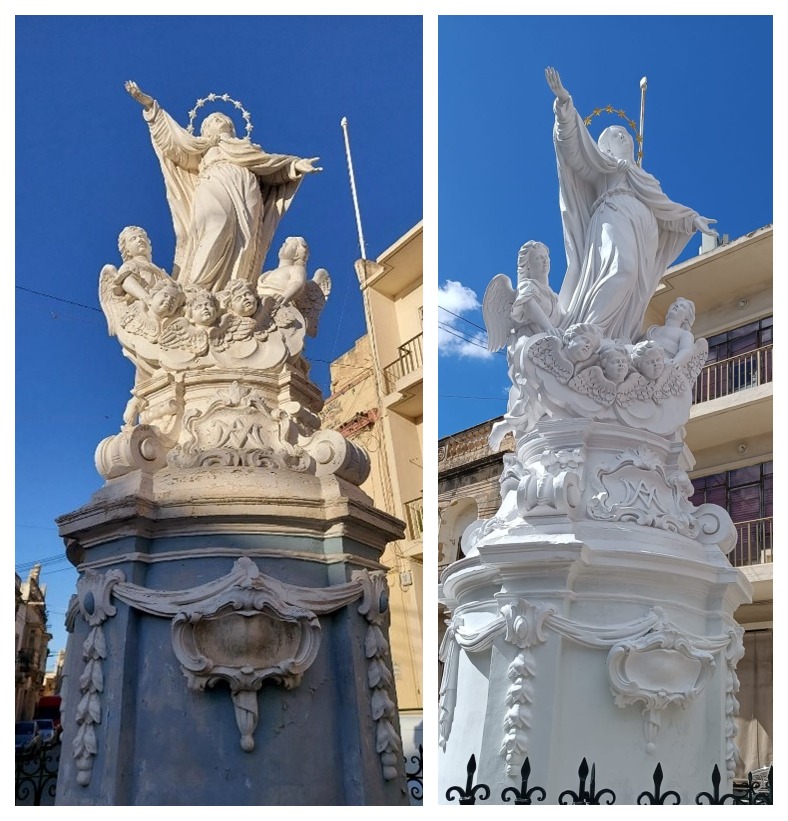
Restoration of the statue of the Assumption of St. Mary in Gudja
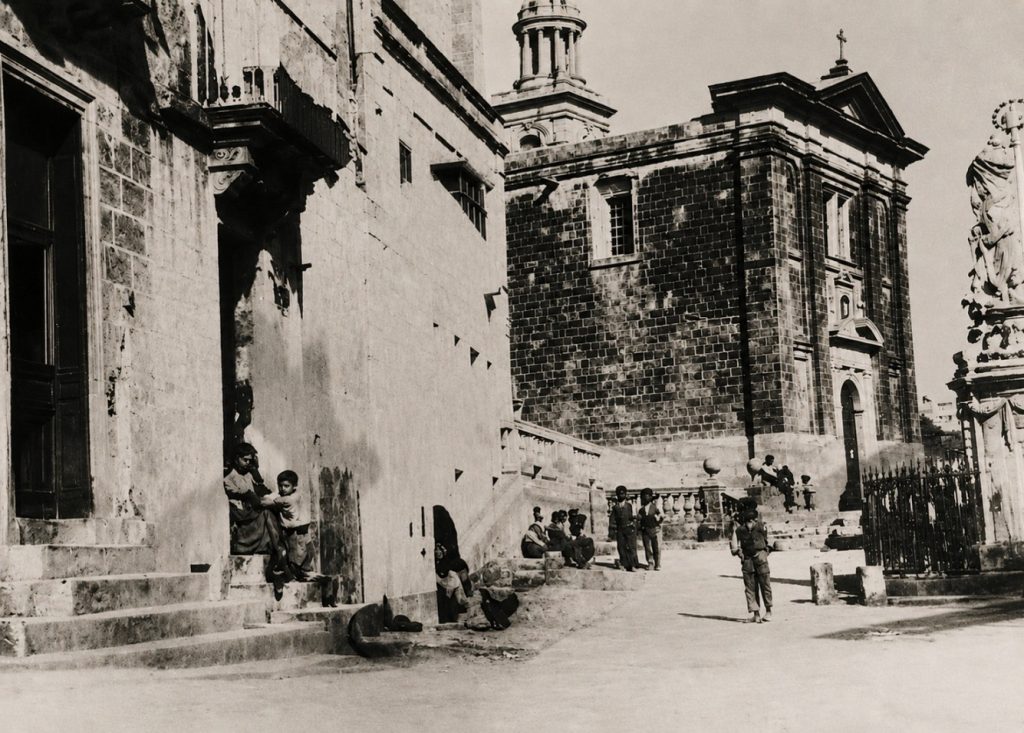
At the heart of Gudja lies the church square, where one finds a beautiful stone statue dedicated to the Virgin Mary. The statue was sculpted by Mastru Xandru Farrugia (1791-1871) and displays a high degree of artistic craftsmanship, particularly in the detailed treatment of the Virgin’s mantle and garments. ¹ The putti forming the base of the statue are also noteworthy for their fine and elaborate sculptural work. Another interesting feature is the inclination of the Virgin’s head together with the expressive positioning of her hands.
The origins of the statue is connected to a violent hurricane that struck Malta on 29 October 1757. ² The hurricane is reported to have caused widespread destruction across the islands, claimed several lives and uprooted a number of trees. One of the hurricane’s victims was an ancient and well-known carob tree that stood in the Gudja square.3 This tree was renowned not only for its age but also for its extraordinary girth. Some time after the hurricane, the people of Gudja raised funds to erect a statue of the Assumption of the Blessed Virgin Mary on the site formerly occupied by the carob tree, reflecting the village’s long-standing devotion to its patroness and protector.
When the statue was built, Bishop Vincenzo Labini (1735–1807) granted an indulgence of forty days to those who recited the Salve Regina before the statue. Among its devotees was Pietru Zammit, a resident of Gudja, who lit the lamp before the statue every day. To ensure that this devotion would continue after his death, he bequeathed a small parcel of land in the vicinity of the village, known as “Ċinċja”, so that the income derived from it would provide the oil necessary to keep the lamp perpetually burning.
Restoration works
The restoration works commenced with the careful removal of multiple layers of paint that had accumulated over the years on both the statue and its pedestal. Residual deposits were removed by a combination of dry and wet brushing techniques. Open and deteriorated joints were cleaned and repointed, while areas of damaged stone were repaired using the plastic repair technique to the original profile. Following the completion of the conservation works, the statue and pedestal were painted with several coats of primer and finishing paint to ensure a durable and uniform protective finish. The ornamental wrought-iron protective railing enclosing the statue and its pedestal was also repainted.
References:
- Terribile, T. (2000). Niċeċ u Statwi fit-Toroq Maltin. Pubblikazzjonijiet Indipendenza.
- Brydone, P. (1773). A tour through Sicily and Malta / Vol. I.
- Gatt, Ġ. (1927). Niċeċ u statwi. Il-Malti, 4.