


Restoration of Saint Catherine’s Statue, Parish Church Parvis, Żejtun.
Saint Catherine of Alexandria was a noble and learned young woman who lived at the beginning of the fourth century. 1 According to tradition, she challenged Emperor Maximinus Daia when he ordered the worship of pagan gods and was consequently condemned to death in AD 305.
Devotion to her spread from Mount Sinai throughout Europe, particularly after her relics reached France in the eleventh century. By the Middle Ages, she had become one of the Church’s most popular saints, serving as patroness of theologians, students, and various trades. Through the Crusades, her cult expanded even further, and numerous churches were dedicated to her.
In the Maltese islands, devotion to Saint Catherine was already present by the fifteenth century. This is implied by two references in the 1436 Rollo: a Cathedral Prebenda Sanctae Catherinae (a type of Cathedral income assigned to a cleric) and a chapel dedicated to her.2 Żejtun’s own association with the saint became especially prominent as up to 1797 the locality was also known as Casale Santa Caterina, and the parish church itself is dedicated to her. 3 Nowadays, a statue of this saint can be found on church parvis. The statue seen today, created by an unknown artist, replaced an earlier work by Giovanni Farrugia, son of the renowned sculptor Xandru Farrugia. 4 This earlier statue had been commissioned towards the end of the nineteenth century together with another statue of Saint Rocque for the church parvis. However, the statues were considered too large for their intended location and were transferred to the cemetery adjacent to the Church of Saint Gregory. 5 New statues were then produced for the parvis and placed on a pedestal designed by Mastru Ġużeppi Zahra.6 In 1899, Bishop Pietro Pace granted a 40-day indulgence to all those who devoutly recited prayers before this image.7
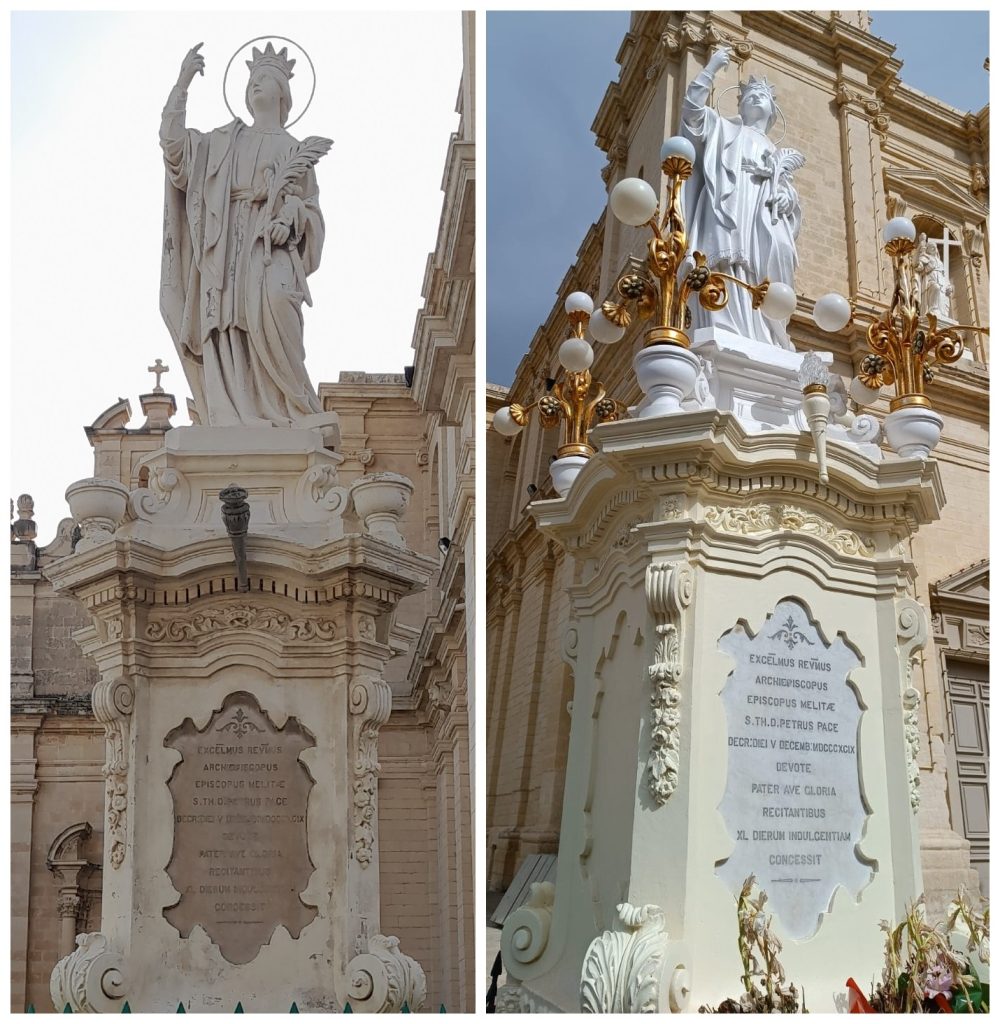
Restoration works
The restoration works commenced with the careful removal of multiple layers of paint that had accumulated over the years on both the statue and its pedestal. Residual deposits were eliminated through a combination of dry and wet brushing techniques. Open and deteriorated joints were cleaned and repointed, while areas of damaged stone were repaired using the plastic repair technique to reinstate the original fabric. The head of the statue, which was at risk of coming off, was securely reattached using a fibre glass rod to provide improved structural stability while preserving the integrity of the original sculpture. Following the completion of the conservation works, the statue and pedestal were painted with several coats of undercoat and finishing paint to ensure a durable and uniform protective finish. Finally, the incised lettering of the marble inscription was carefully repainted with black paint to improve their legibility while respecting its original appearance.
References
- Farrugia, J. (2005, November 6). Santa Katerina ta’ Lixandra. In Santa Katerina ta’ Lixandra Il-Kult Tagħha. Akkademja Mużiko-letterarja fil-Monasteru Ta’ Santa Katarina Ta’ Lixandra fil-Belt Valletta Fl-okkażjoni tas-Sbatax-il Ċentinarju Mill-martirju U L-glorifikazzjoni Ta’ Santa Katarina Ta’ Lixandra, Valletta, Malta.
- Borg, V. (2008). MELITA SACRA I**: The Maltese diocese and the Sicilian environment from the Norman period till 1500AD (Vol. 2). Self-Published.
- Cassar, C. (1981). “O Melita Infelix”, a poem on the Great Siege written in 1565. Melita Historica, 8(2), 149-155.
- Debono, S. (1989). Sta. Katerina fil-folkore Malti x-xbihat u n-niċċeċ ta’ Santa Katerina fiż-Żejtun. Għaqda tan-Nar 25 ta’ Novembru. Żejtun.
- Wirt Iż-Żejtun. (2023, November 22). In-Numru mija u tmienja u għoxrin (128) mis-sensiela “Nitfa Storja” – Statwa ta’ Santa Katarina. Facebook. Retrieved July 16, 2026, from https://www.facebook.com/story.php?story_fbid=830420662424702&id=100063703261060
- Debono, S. (1989)
- Ciantar, N. (2013). Ġabra ta’ Statwi u Niċeċ Reliġjużi fit-Toroq ta’ Malta u Għawdex.