
Restoration of frontispiece and bell-cot, Oratory of the Crucifix, Basilica of Our Lady of Victories, Senglea
Senglea began to develop following the arrival of the Order of St John in Malta. After the siege of 1551, Grand Master Juan d’Homedes built Fort St Michael, while Claude de la Sengle further developed the fortifications around the peninsula. In 1554, Senglea was granted city status and officially named after Grandmaster de la Sengle. During the Siege of 1565, the city resisted the Ottoman attacks and was awarded the title Civitas Invicta – the Unconquered City. Following the siege, Senglea’s population increased. Due to this, a larger church dedicated to the Nativity of Our Lady was built which eventually became a parish church in 1581. From the time it was built up to the present day the church has undergone many changes, especially after the damage it suffered during the Second World War. 1
In 1727, the Confraternity of the Crucifix commissioned Senglean architect Claudio Durante and master mason Francesco Zerafa to construct the Oratory of the Crucifix adjoining the church. The works were completed in 1731 and the oratory was embellished with elaborate sculptural work by Pietro Paolo Zahra. 2 The Oratory is administered by the Confraternity of the Most Holy Crucifix founded on 14 January 1719 with the approval of the ecclesiastical authorities. Its members gathered there on designated days for prayer and devotion in accordance with the Confraternity’s statutes.3
During his pastoral visitation of 1736–1740, Bishop Alpheran de Bussan described the recently constructed Oratory of the Most Holy Crucifix as an oblong, modern structure adjoining the choir of the church. Its vaulted interior, illuminated by two small lanterns, was richly decorated with stone carvings including the Four Evangelists, angels bearing the Instruments of the Passion and representations of four principal episodes from Christ’s Passion. The oratory was furnished with finely worked chestnut seating and a pulpit, while its elaborately carved oval tribune contained a richly adorned altar. Above the altar stood a large wooden Crucifix, described as an elegant work made in Rome.4
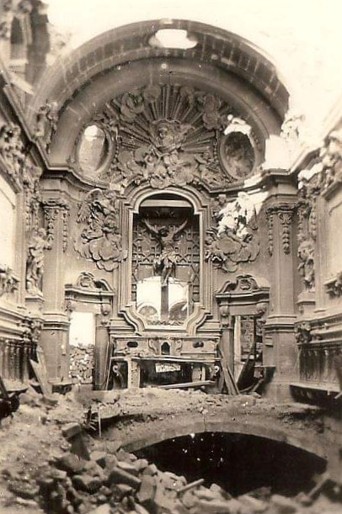
During the Second World War, the Basilica of Senglea suffered extensive damage from aerial bombardment. The destruction began in January 1941 and intensified until April 1942, when the dome collapsed and the choir and parts of the Oratory of the Crucifix were destroyed, while the façade was also severely damaged. After the war, architects Giuseppe Mallia Milanes and Giuseppe Caruana oversaw the reconstruction of the church, largely retaining its original form and style. Extensive sculptural work was carried out by Marco Montebello, who left a significant mark on the appearance of the rebuilt church.5 By 30th August 1947, the Oratory was restored, blessed and open for confraternity members. 6
The most important work housed in the Oratory is the revered image of Christ the Redeemer, which has long attracted devotees from across Malta and Gozo. The statue was created around 1742 by Saverio La Ferla (c. 1695–1761), who is regarded as the first Maltese statuary artist to work in papier-mâché. La Ferla produced several processional statues for Maltese churches and confraternities. Over the years, the statue of the Redeemer itself has undergone several restoration interventions.7
Restoration works
The restoration and maintenance works to the rear of the frontispiece and the small bell tower of the Oratory of Senglea Parish Church were completed in 2024. The intervention addressed various forms of deterioration including the degradation of the limestone bases, cracks within the masonry blocks and structural cracking. The works were carried out by the Restoration and Preservation Department.
References:
- Caruana, M. (2009). Il-Knisja Bażilika ta’ Marija Bambina fl-Isla u Dak Kollu li Jgħaniha. (L-Ewwel Parti). L-Isla. Leħen il-Parroċċa. Festa Marija Bambina 2009.
- Caruana, M. (2009).
- Archives of the Archbishop’s Curia, V.P. XXXIII, Alpheran de Bussan, 1736-1740, f.1067 – f.1070
- Alpheran de Bussan, 1736-1740.
- Caruana, M. (2009).
- Caruana, M. (2015). Bini Marbut mal-Knisja (it-tielet parti). Festa Marija Bambina, Senglea, 11–21.
- Farrugia, J. (Ed.). (2019). Ir-Redentur: History, Art, and Cult of the Miraculous Effigy of Christ the Redeemer at Senglea, Malta. Midsea Books.