


Restoration of St. Roche Statue, Parish Church Parvis, Żejtun
Saint Roche was born in Montpellier, France, in 1295, but spent much of his life in Italy. 1 He is renowned as the patron saint invoked against the plague. According to tradition, Saint Roche cared for plague victims and later contracted the disease himself while in Piacenza, withdrawing to a forest to avoid spreading it. During this time, a dog is said to have brought him bread each day, which is why this animal became one of his main attributes and is often shown beside him in artistic representations.
After the plague of 1592-1593, devotion to Saint Roche spread across the Maltese Islands. 2 This devotion is still echoed in chapels, niches, statues and other representations erected over the centuries as an expression of devotion and as an appeal for protection against the plague. Amongst these works is the statue of St Roque in Żejtun which stands on the parvis of the parish church.
The statue seen today, created by an unknown artist, replaced an earlier work by Giovanni Farrugia, son of the renowned sculptor Xandru Farrugia. 3 This earlier statue had been commissioned towards the end of the nineteenth century together with another statue of Saint Catherine for the church parvis. However, both statues were considered too large for their intended location and were transferred to the cemetery adjacent to the Church of Saint Gregory.4 New statues were then produced for the parvis and placed on pedestals designed by Master Ġużeppi Zahra.5 In 1899, Bishop Pietro Pace granted a 40-day indulgence to all those who devoutly recited prayers before this image.6
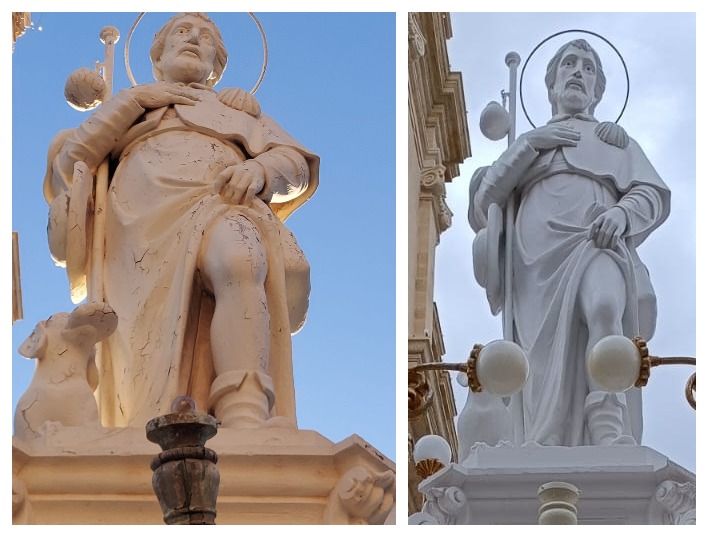
Restoration works
The restoration works commenced with the careful removal of multiple layers of paint that had accumulated over the years on both the statue and its pedestal. Residual deposits were eliminated through a combination of dry and wet brushing techniques. Open and deteriorated joints were cleaned and repointed, while areas of damaged stone were repaired using the plastic repair technique to reinstate the original fabric. Following the completion of the conservation works, the statue and pedestal were painted with several coats of undercoat and finishing paint to ensure a durable and uniform protective finish. Finally, the incised lettering of the marble inscription was carefully repainted with black paint to improve their legibility while respecting its original appearance.
References:
- Ciantar, N. (n.d.). Santu Rokku ta’ Montepellier. Kappelli Maltin www.kappellimaltin.com. Retrieved July 15, 2026, from https://kappellimaltin.com/Kitbiet/Qaddisin/Santu_Rokku/santu_rokku.html
- Borg, V. (2009). MELITA SACRA II: The Maltese Diocese during the Sixteenth Century. the author.
- Debono, S. (1989). Sta. Katerina fil-folkore Malti x-xbihat u n-niċċeċ ta’ Santa Katerina fiż-Żejtun. Għaqda tan-Nar 25 ta’ Novembru. Żejtun.
- Wirt Iż-Żejtun. (2019, August 23). In-numru tlieta u ghoxrin mis-sensiela ta’ “Nitfa” Storja’ 🔍 – Is-Statwa ta’ Santu Rokku! Facebook. Retrieved July 15, 2026, from https://www.facebook.com/photo/?fbid=2433534806734288
- Debono, S. (1989)
- Ciantar, N. (2013). Ġabra ta’ Statwi u Niċeċ Reliġjużi fit-Toroq ta’ Malta u Għawdex.